Small blocks are not small farms
Fencing a lifestyle block around Orange is a different job from fencing a grazing paddock. The runs are short, there are more corners and gates for the length, the fence is seen from the house every day, and the animals inside are often horses, a few sheep, alpacas or the neighbour's dog. Looks and safety count for as much as strength.
The ring of small acreage around Orange, out through Nashdale, Clifton Grove, Spring Hill and Millthorpe, and around Bathurst, is where most of these enquiries come from. Many of the blocks were cut from older farms, so the first question is often what to do with a tired stock fence that came with the place.
Fence types for horses
We found no horse fencing standard in the public sources we read, so this page does not rank the options. What follows is what contractors commonly offer and what owners usually weigh up.
| Fence | What owners like | What to think about |
|---|---|---|
| Timber post and rail | Highly visible, traditional look, solid barrier | The dearest to build and needs upkeep. Horses chew rails unless a hot wire runs along the top. |
| Post and rail with mesh below | Keeps foals, dogs and small stock in as well | Mesh must be a small enough aperture that a hoof cannot go through it. |
| Plain wire with a sighter | Lower cost over long runs | Plain wire is hard for a horse to see. A top rail, cap or wide tape makes it visible. |
| Electric tape or braid | Quick to build and easy to move | Depends on power and regular checking. Usually paired with a permanent fence on boundaries. |
Most horse owners avoid barbed wire and standard stock netting, because a horse that puts a leg through either tends to come off badly. If the existing fence on your block is barbed, contractors can often pull the barb and add an electric offset as a lower-cost first step than a full replacement.
Posts, cold ground and rot
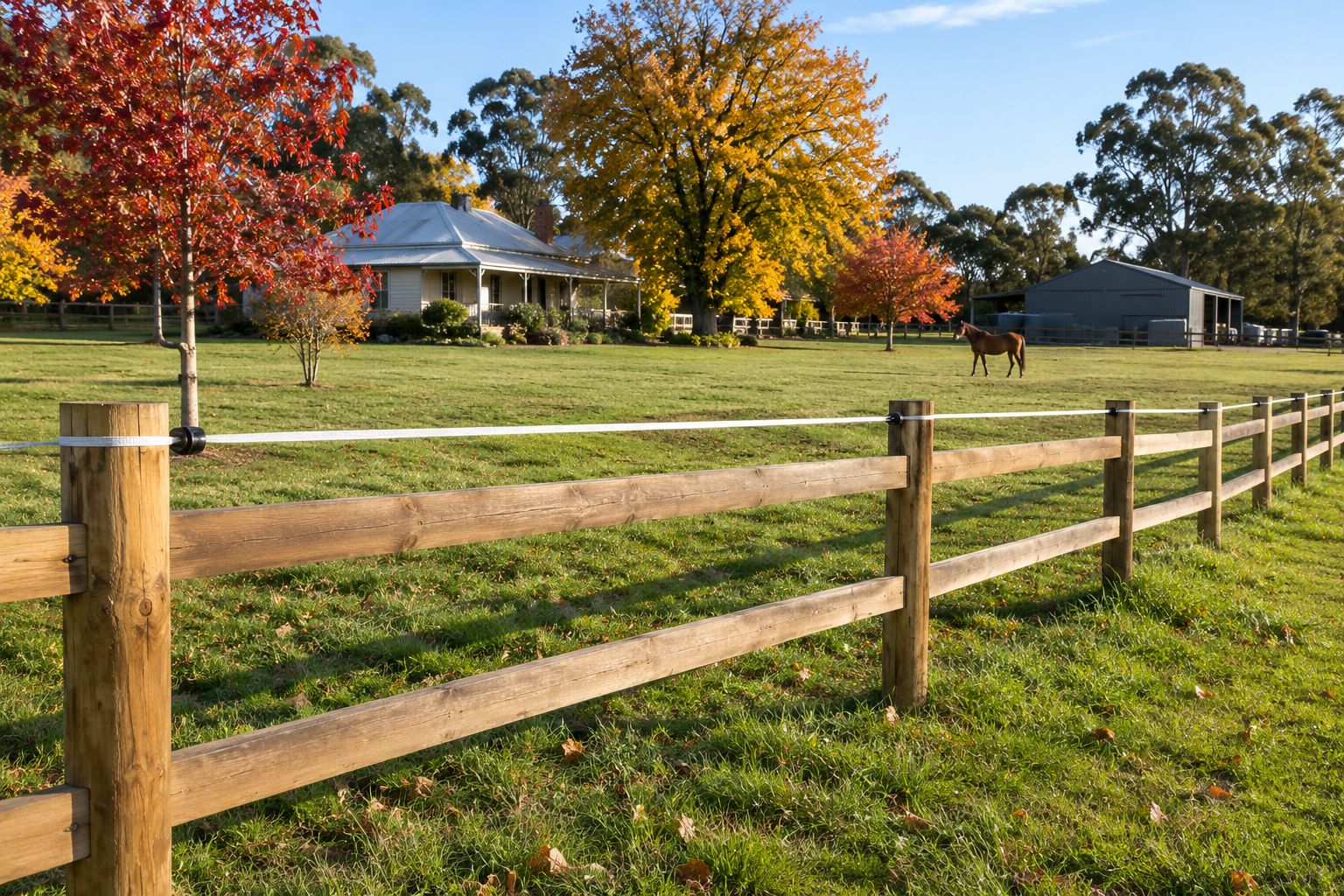
Timber rail fences live or die at ground level. A timber industry education body rates species into four durability classes for in-ground use and says treated softwood posts should be specified to the H4 level (timber industry guidance). Orange is wet and cold for much of winter, with a mean annual rainfall over 900 mm at the Bureau of Meteorology station (Bureau of Meteorology), so posts sit in damp soil for months. Ask what the posts are, what class or treatment level they carry, and whether rails are fixed so water does not sit in the joins. The guide to how long fences last goes further.
Council rules on small blocks
NSW planning guidance says fences in rural zones and large lot residential areas can often be built without approval if they are post and wire or post and rail and stay under 1.8 m, with exceptions for heritage items and some sensitive land (NSW Planning). Solid, masonry or very tall fences are a different matter. Lifestyle blocks sit in a mix of zones, so check with the council that covers your block, and see the approvals guide.
Neighbours on small blocks
Boundary fences between lifestyle blocks follow the same dividing fence rules as farms, but the arguments are different: one owner wants rails, the other is happy with wire. The usual answer is that both share the cost of a sufficient fence and whoever wants more pays the extra. Farm boundary fencing sets out the order to do things in.
Layout is half the job
Before the contractor visits, sketch where you want gates, laneways, a day yard, shelter and water. Gates wide enough for a float, a hay delivery or a fire truck are much dearer to add later. Corners in horse paddocks are often rounded or cut off so a horse cannot be trapped by another. A contractor who builds horse fencing will have a view on all of this, so ask.
Send the block location, the animals, a sketch and a few photos through the quote form.
What this page cannot promise
No fence makes a horse safe. Horses run through, jump and lean on every kind of fence, and this page cannot tell you which design suits your animals. It does not set out a standard, because we did not find one, and the table above is a summary of common practice, not advice for your paddock. A contractor experienced with horses, and your own vet or instructor, are better guides than a website.
Check the current rules before you rely on this
This page describes the fence types contractors commonly build for horses and small acreage around Orange and what public sources say about approvals and timber posts. It describes the rules in general terms as they stood in November 2026. Standards, forms, thresholds and fines change.
The authoritative sources are NSW Planning, fences (exempt and complying development), Australian timber industry education body, fencing (durability classes and treatment), Bureau of Meteorology, Orange Agricultural Institute climate statistics (station 063254) and Dividing Fences Act 1991 (NSW), in-force version dated 7 December 2024 (check the current version). Where anything here differs from those sources, they are right and we are not.
We are not fencing contractors, builders, regulators or lawyers. For what applies to your fence, ask the contractor which licence or registration they hold for your job, then ask NSW Fair Trading or Building Commission NSW if you are unsure, and ask the council that covers the land.
Accurate at the time of writing, November 2026. Always check the source before relying on it.