The short answer
How long a rural fence lasts depends on its weakest part, and around Orange that is usually a timber post at ground level or a strainer that has started to lean. The wire often outlives both. No public source we read gives a life for a whole fence, so this page gives none. It sets out what wears a fence out and what you can specify to slow that down.
Timber in the ground
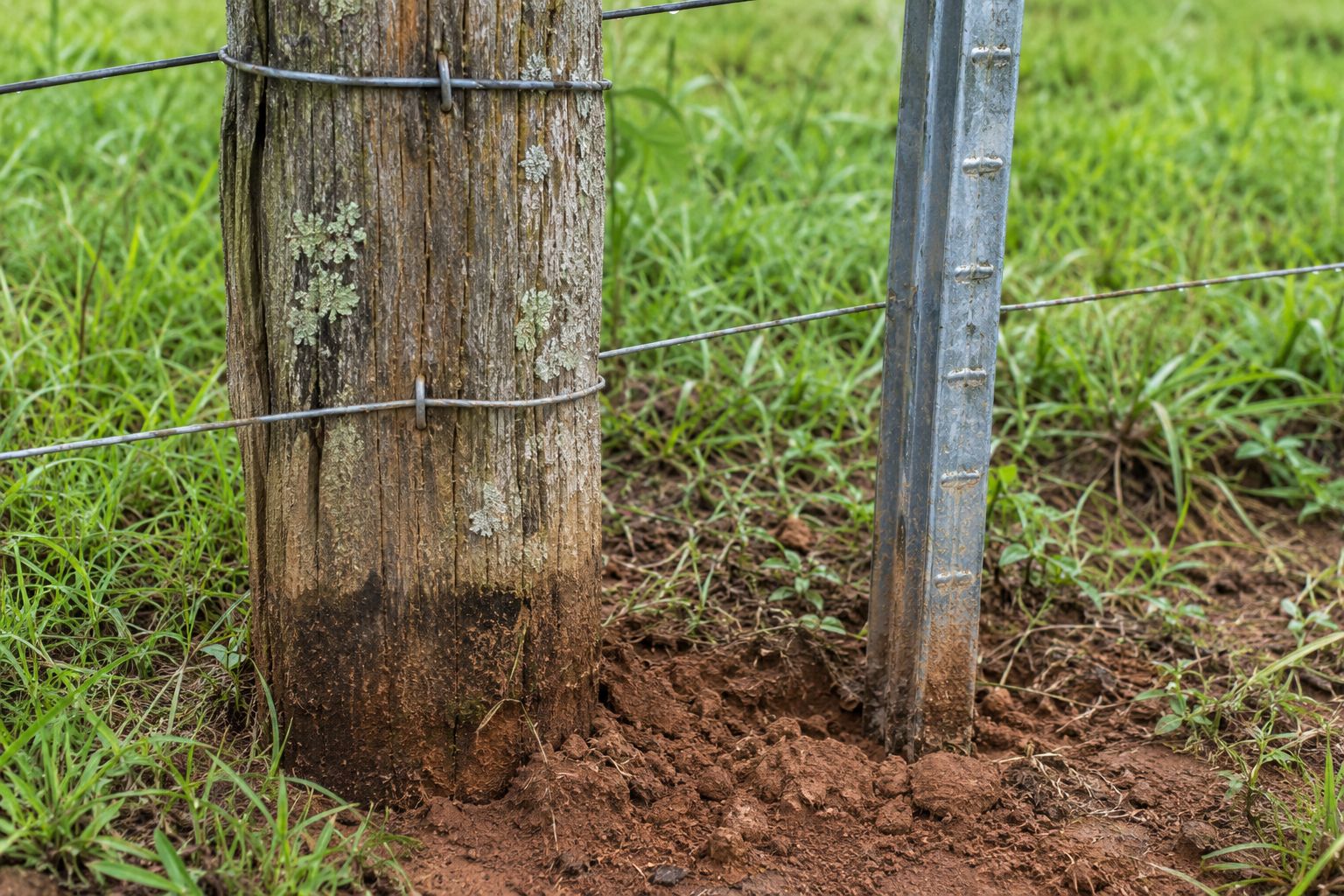
Timber posts fail where soil, air and moisture meet. A timber industry education body sorts species into four durability classes for in-ground use, with class 1 the most durable and class 4 the least. It says fence posts should ideally come from durability class 1 or 2, which should give at least 15 years in the ground, and that treated softwood posts should be specified to the H4 treatment level (timber industry guidance).
Three things follow from that for a buyer:
- "Hardwood" on a quote is not enough. Ask for the species and its durability class.
- "Treated pine" is not enough either. Ask for the treatment level, and check the stamp or tag on the posts when they arrive.
- Durability ratings refer to heartwood. A post with a lot of sapwood will not behave like the rating suggests unless it has been treated.
Orange is hard on timber because the ground stays damp. The Bureau of Meteorology's station there averages 924 mm of rain and a mean July minimum of 1.6 degrees, so soil around a post can be wet for months on end (Bureau of Meteorology). Posts in gullies and soaks go first.
Steel posts and wire
Steel does not rot, but it rusts once its coating is gone. The life of a steel picket or a run of wire is mostly the life of its galvanising, and makers sell several coating weights. One manufacturer's data sheet for hinge joint netting, for example, claims its heavier coating outlasts standard galvanising several times over (one manufacturer's data sheet). That is the maker's claim and we cannot test it, but it tells you the coating is something to ask about.
| Part | What wears it out | What to ask or do |
|---|---|---|
| Timber strainers and posts | Rot at ground level, worst in wet ground | Species and durability class, or treatment level |
| Steel pickets | Rust once the coating is breached, bending under stock or machinery | Coating type and weight of picket |
| Wire and netting | Coating loss, then rust. Over-straining. Fire. | Wire grade and coating class |
| Strainer assemblies | Leaning under constant load, especially on slopes and in soft ground | Depth, stay design and footing |
| Gateways | Sagging hinge posts, stock pressure, vehicles | Post size and whether the gate is supported when open |
| Creek crossings | Flood debris and scour | Whether the crossing is separate from the main run |
Tension and strainers
A fence is a tensioned structure. If the ends move, everything between them goes slack, stock start pushing through and the damage speeds up. On hill country the strainers work harder, because the wire pulls up or down on them as well as along. A well-built end assembly on good footing does more for the life of a fence than any upgrade to the wire. Ask the contractor how deep the strainers go and how they are stayed. Stock fencing covers what to ask about hill lines.
Water, stock and neglect
Floods end fences early. Victorian Government guidance for riparian fences in flood-prone areas, an interstate source, says no fence can be designed to withstand a major flood, which is why crossings are best built as separate sections that can be lost and replaced (Victorian riparian fencing guidance).
Stock are the daily wear. Cattle rub and lean, sheep push under, horses chew rails. An electric offset wire is the usual way to keep animals off a fence, and electric fencing explains how that works.
The last cause is the plainest. Fallen limbs left on the wire, a broken strand not tied off, growth pulling netting down: small faults that cost little to fix in the first month and a lot by the third winter. A fence that is walked twice a season lasts longer than one that is not.
Repair or replace
If the strainers are sound and the wire still takes tension, replacing posts and re-straining can be good value. If the strainers are leaning and the wire snaps when strained, the fence is finished and patching it costs more in the end. A contractor can test a section in a few minutes. The cost factors guide explains what a replacement quote should list.
What this guide cannot tell you
This guide cannot put a number on the life of your fence, your wire or your posts. The one figure above is an industry body's expectation for timber of durability class 1 or 2 in ground contact, not a promise and not specific to Orange soils. It cannot tell you whether a product claim is true. And it cannot inspect a fence. If a fence matters, have a contractor test the strainers and the wire before deciding what to spend.
Check the current rules before you rely on this
This page describes what public sources say about the durability of timber posts, wire coatings and fences in flood-prone ground. It describes the rules in general terms as they stood in November 2026. Standards, forms, thresholds and fines change.
The authoritative sources are Australian timber industry education body, fencing (durability classes and treatment), One manufacturer's hinge joint livestock fence data sheet (manufacturer claims are the manufacturer's), Bureau of Meteorology, Orange Agricultural Institute climate statistics (station 063254) and Victorian Government, guidelines for riparian fencing in flood-prone areas (2015; Victorian guidance, interstate). Where anything here differs from those sources, they are right and we are not.
We are not fencing contractors, builders, regulators or lawyers. For what applies to your fence, ask the contractor which licence or registration they hold for your job, then ask NSW Fair Trading or Building Commission NSW if you are unsure, and ask the council that covers the land.
Accurate at the time of writing, November 2026. Always check the source before relying on it.