Fencing where the water goes
Rural fencing around Canowindra and Eugowra has to be planned around flood. Canowindra sits on the Belubula River and Eugowra on Mandagery Creek, and both towns were named by Cabonne Council as priorities for temporary flood barriers after 2022. The council's recovery page describes Eugowra as devastated by the flood that November (Cabonne Council).
For a landholder on those flats, that changes the question from "what fence do I want" to "what fence am I prepared to lose, and how much of it". A fence on a floodway is a consumable. The aim is to lose a short, low-cost section instead of a long, expensive one.
Designing for the next flood
We found no NSW guide written for farm fences on floodplains, so the best public source is from over the border. Victorian Government guidance for riparian fences in flood-prone areas, an interstate source, makes these points (Victorian riparian fencing guidance):
| Idea | How it helps |
|---|---|
| Run fences with the flow where you can | Water and debris slide along the wire instead of piling against it |
| Plain wire, not netting or barbed, across flow paths | Less debris caught, and easier to clean and re-strain |
| Independent strainers each side of a crossing | A lost section does not drag the next one down |
| Floodgates or drop-down sections | The fence gives way on purpose and is reset afterwards |
| Electric wires on the lowest ground | A few wires are quick to replace and catch little |
| Gates on higher ground | You can still move stock when the flat is under water |
Ask the contractor which of these suit your paddocks. Electric fencing explains the energiser and cut-out switch side, and flood and fire fence repair covers what to do straight after an event.
Flats and hills on the one place
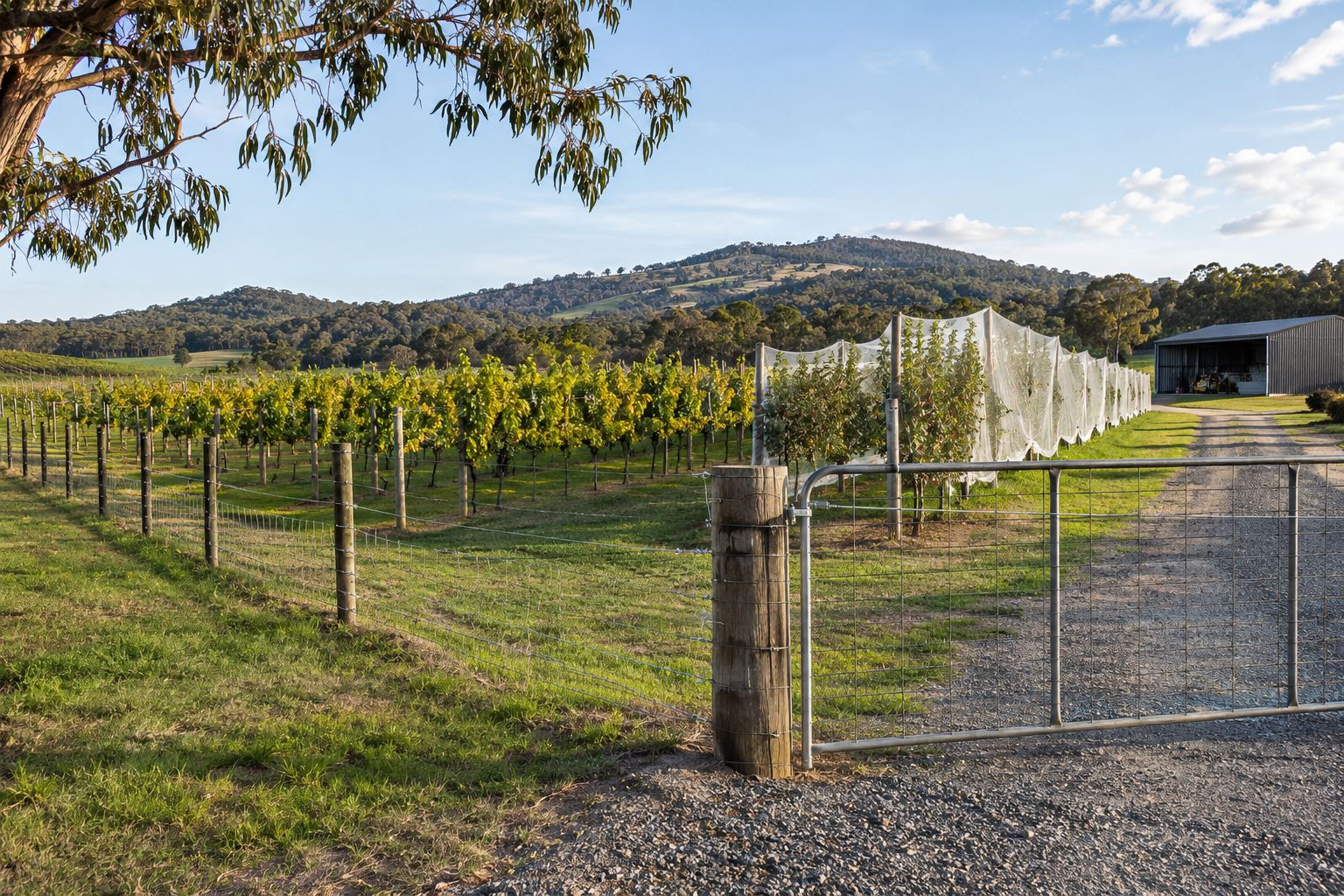
Many properties here run from river flat up into hill country, and the two halves want different fences. The flats carry lucerne, crops, vines and the best grazing, on deep soil that drives easily but floods. The hills are drier and rockier, safe from water and slower to fence. A good plan treats them separately: light and sacrificial below the flood line, permanent and heavier above it, with the boundary between them placed where the water usually stops.
Vineyards, orchards and stock next door
Horticulture and grazing share boundaries in this valley. A grower wants stock kept out without exception, because a few hours of cattle in young vines is a season's damage. A grazier wants a fence that holds sheep and does not need to be taller than that. The usual settlement is a shared stock fence, with the grower adding height, mesh or a hot wire at their own cost. Farm boundary fencing sets out how to agree it.
Who covers this district
Canowindra, Eugowra and Cargo are in the Cabonne council area, which at the 2021 Census had 13,766 people and counted specialised sheep farming and specialised beef cattle farming among its three largest employing industries (ABS QuickStats, Cabonne). Planning questions go to Cabonne Council. Contractors come out from Orange, Cowra and the local district, so say exactly where you are.
Getting it quoted
Send the locality, whether the line floods and how often, what it has to hold and a rough length through the quote form. If you have photos from the last flood showing where the water ran, send those too. They are the best brief a contractor can get. For help with costs after a declared event, see the assistance guide.
What this page cannot tell you
This page cannot tell you where the next flood will reach or which of your fences will survive it. The design ideas come from Victorian guidance for riparian fences, not from a NSW standard, and they reduce losses without preventing them. The census figures describe all of Cabonne. For flood levels and mapping on your property, ask Cabonne Council. For the fence, ask a contractor who has rebuilt on these flats.
Check the current rules before you rely on this
This page describes flood-prone farming country around Canowindra and Eugowra and what public sources say about fencing it. It describes the rules in general terms as they stood in November 2026. Standards, forms, thresholds and fines change.
The authoritative sources are Cabonne Council, flood recovery information and support, Victorian Government, guidelines for riparian fencing in flood-prone areas (2015; Victorian guidance, interstate), ABS 2021 Census QuickStats: Cabonne (local government area) and NSW Government, Fence Rebuilding Program extension round (closed; historic). Where anything here differs from those sources, they are right and we are not.
We are not fencing contractors, builders, regulators or lawyers. For what applies to your land, ask Cabonne Council about flood mapping and planning, Local Land Services and the Rural Assistance Authority about recovery help, and the contractor how the fence will be built.
Accurate at the time of writing, November 2026. Always check the source before relying on it.